


What Does HY Mean in Text?
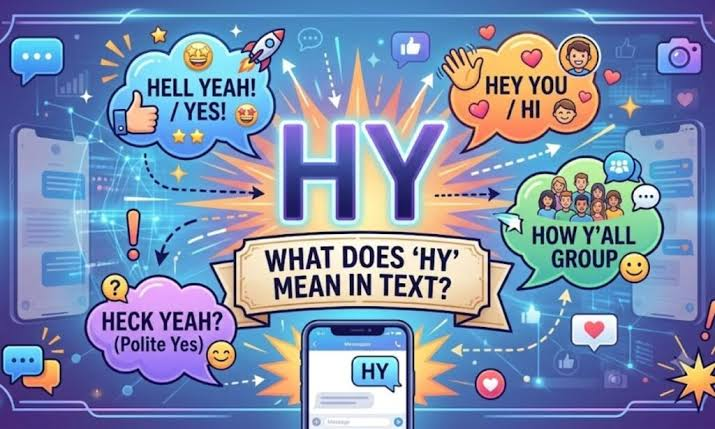
What does hy mean in text? In most casual conversations, HY is commonly used as a shortened form of “hey,” particularly when someone wants to greet another person quickly. However, texting language is flexible, and the meaning can change depending on the conversation, relationship, and platform. Unlike formal language, digital communication often rewards speed and simplicity. Therefore, two letters can sometimes carry the warmth of a greeting, the urgency of a question, or an entirely different meaning. Context remains the most reliable way to understand it.
Why Two Letters Can Say So Much
Texting has developed its own informal vocabulary, shaped by speed, convenience, smartphones, and social media. Consequently, abbreviations such as “brb,” “idk,” and “lol” became familiar parts of everyday digital communication. HY belongs to this broader culture of compressed language, although it is less standardized and therefore more dependent on context. A person might type it simply because they are rushing, while another may use it as a casual greeting. In both cases, the meaning is usually understood through the surrounding words rather than the abbreviation alone.
HY as a Casual Greeting
One of the most straightforward interpretations of HY is “hey.” In this sense, it functions almost exactly like a relaxed opening to a conversation. Someone might send “HY, what’s up?” or simply write “HY” when beginning a chat. The tone is generally informal rather than professional. Moreover, the short form can feel particularly natural in fast-moving conversations where participants are already comfortable with one another. For that reason, seeing HY at the beginning of a message does not necessarily signal anything mysterious; it may simply be digital shorthand for saying hello.
Context Determines the Meaning
Although “hey” is a common interpretation, readers should avoid assuming that every occurrence has exactly the same meaning. Text abbreviations are often personal, community-specific, or platform-specific. For example, friends may develop their own shortcuts that outsiders would find confusing. Similarly, a particular group chat might give an abbreviation a meaning that differs from its usual interpretation. Therefore, the sentence surrounding HY matters greatly. Looking at who sent the message, what was discussed previously, and what follows the abbreviation can usually provide enough information to determine the intended meaning.
When HY Can Be Misunderstood
The biggest challenge with short texting abbreviations is that they remove the clues normally provided by speech. In face-to-face conversation, tone of voice, facial expression, and timing help communicate intention. Text removes much of that information. As a result, even a harmless greeting can occasionally seem abrupt or confusing. HY might appear friendly to one reader but overly casual to another. Nevertheless, this does not mean the sender intended anything negative. Digital communication frequently leaves emotional interpretation to the reader, making context and familiarity especially important.
Reading the Tone Behind the Message
The meaning of an abbreviation is not only about vocabulary; it is also about tone. If someone writes “HY 😊,” the message may feel warm and welcoming. By contrast, “HY?” could sound more like a quick attempt to get someone’s attention. Meanwhile, a message such as “HY, are you free?” simply uses the abbreviation as an efficient conversational opener. Therefore, punctuation, emojis, capitalization, and the rest of the sentence can influence how the message feels. Understanding texting language requires reading these small signals together rather than focusing on two letters in isolation.
HY and the Evolution of Internet Language
The popularity of abbreviations reflects a larger transformation in how people communicate. Earlier generations adapted language to letters, postcards, and telephone conversations; today’s users adapt it to keyboards, notifications, and instant messaging. Consequently, digital language often prioritizes immediacy over grammatical completeness. Short expressions can create a sense of belonging because people who understand them share an informal linguistic code. At the same time, these expressions constantly evolve. An abbreviation that feels obvious to one generation or online community may be unfamiliar to another, demonstrating how quickly communication habits change.
A Quick Guide to Interpreting HY
| Context | Likely interpretation | Typical tone |
|---|---|---|
| “HY, how are you?” | Hey | Casual and friendly |
| “HY 😊” | Hey | Warm and informal |
| “HY?” | Hey / attention-getter | Brief or direct |
| Group-specific conversation | Depends on the community | Context-dependent |
| Unclear or unusual usage | Ask the sender | Neutral |
The table illustrates an important point: there is no universal dictionary rule that determines every use of HY. Instead, interpretation depends on the linguistic environment in which it appears. If the surrounding conversation clearly suggests a greeting, “hey” is probably the intended meaning. However, when the abbreviation appears unexpectedly or seems inconsistent with the discussion, asking the sender is more reliable than guessing. In informal digital communication, clarification is often the simplest solution, especially when a misunderstanding could affect an important conversation.
Why People Prefer Short Forms in Chats
Speed is one major reason abbreviations continue to thrive. People communicate while commuting, working, watching television, or moving between different tasks. Therefore, typing two characters can feel more natural than writing a complete greeting. Beyond efficiency, however, shortened language can also communicate familiarity. Friends rarely need formal introductions every time they begin talking. A compact greeting can reinforce the relaxed atmosphere of a conversation. Furthermore, the informal nature of abbreviations helps distinguish private chats from formal communication, where complete words and conventional grammar are generally more appropriate.
Should You Use HY in Professional Messages?
Generally, caution is advisable. While HY may be perfectly acceptable between friends, family members, or familiar online contacts, professional communication usually benefits from clearer language. Starting an email with “Hey” may already be informal in some workplaces, while an unexplained abbreviation could appear careless or ambiguous. Consequently, writing the full greeting is usually safer when communicating with clients, employers, teachers, or unfamiliar colleagues. The objective is not to reject digital shorthand but to match the language to the relationship, setting, and expectations of the person receiving the message.
The Human Side of Texting Abbreviations
Small expressions such as HY reveal something surprisingly significant about modern communication: people continually reshape language to fit their lives. What appears to be a minor shortcut can reflect friendship, familiarity, technological habits, and generational change. Moreover, these abbreviations show that language is not static. It responds to new environments and new social expectations. A tiny greeting typed on a phone can therefore become part of a much larger cultural story about how people maintain relationships when conversations increasingly happen through screens rather than across tables.
Frequently Asked Questions
Is HY the same as “hey”?
Often, yes. In casual texting, HY can be used as a shortened version of “hey,” particularly as an informal greeting. However, context should always be considered because abbreviations can have different meanings in different communities.
Is HY considered formal language?
No. It is generally informal digital shorthand. For professional emails, applications, business messages, or communication with unfamiliar people, a conventional greeting is usually a better choice.
Does HY always mean “hey”?
Not necessarily. Although “hey” is a common interpretation, abbreviations can develop alternative meanings. If the surrounding conversation does not support that interpretation, consider asking the sender what they meant.
Why do people use abbreviations like HY?
Convenience is the main reason. Short forms make messages faster to type and can also create a relaxed, familiar tone between people who regularly communicate online.
Conclusion: More Than Just Two Characters
What does hy mean in text? Most often, it is a quick and informal way of saying “hey,” but its real meaning depends on context. That small distinction matters because texting is not simply spoken language placed onto a screen; it has developed its own conventions, rhythms, and social cues. Ultimately, HY represents the continuing evolution of everyday communication. As digital conversations become even more central to modern life, such tiny expressions will continue to change, disappear, and reappear—quietly documenting how people connect with one another.
